

Where Are Your Fingerprints?
You can't see them until you stop needing to be innocent.
You already know you are in the drama triangle. That is not the hard part anymore. The hard part is finding what you specifically have been doing that keeps it running.
Here is what it actually feels like when the trigger lands: Someone pushes back in a meeting. A team member drops the ball on something that mattered. A colleague takes credit for work that was not theirs. The trigger is fast and the response is faster. If you slow it down enough to watch it, you will find all three roles running at once.
- The villain rises first. The flash of judgment, the internal verdict delivered before the facts are in. They should have known better. This keeps happening. I am the only one who sees it. Not malicious, just certain, and moving too fast for nuance.
- Then the victim pulls. The exhaustion underneath the judgment. Why does this always fall to me? Nobody appreciates what it takes to hold this together. Not weak, just depleted, and looking for somewhere to put the weight.
- Then the hero mobilizes. Fine. I will handle it. I can see what needs to happen, I have the standing to make it happen, and the clock is running. The hero closes the loop, solves the problem, and keeps the system exactly where it is.
The whole sequence can run in under thirty seconds. Most of the time, nobody sees it but you. Sometimes you do not even see it until it is already done, and you are wondering why the room feels the way it does.
The exit is not dramatic. It does not require the internal noise to stop. What it requires is a single different question, or one moment of genuine curiosity about what the other person is actually carrying. That small shift, from verdict to inquiry, from certainty to empathy, is enough to ease the base running. The melodrama may still be playing underneath, but your leadership behavior can change anyway.
That is not mastery. That is the practice. And it starts with knowing what is running inside you before it runs the room.
The next question turns away from the room and onto what you have been doing to make this room work the way it does.
It is always easier to see a pattern than to find your contribution to it. Most leaders develop the ability to name what is happening long before they develop the willingness to ask what they brought to it. Naming it feels like progress. It has language, a framework, a way of seeing. But the gap between naming the pattern and locating yourself inside it is where most leadership development stalls. Crossing that gap requires something uncomfortable: You have to stop being the observer and become the subject.
I have a client who has done serious work on himself as a leader. Years of it. He can spot himself in the villain role almost immediately. That edge of impatience, the tendency to move before the room is ready. He catches the victim pattern too, the moments he feels unappreciated or misread, and names it without much delay. He has real fluency in the triangle.
What he could not see, for a long time, was the hero.
It felt like leadership, not a hidden flaw. His team comes to him regularly, which is reasonable. He is experienced, capable, and knows the business well. When someone brings him a problem, especially when he is pressed for time or moving fast, he answers it. He directs. He advises. He gives more guidance than is his to give. The team, having learned that he will provide the answer if they wait long enough, keeps coming back.
He looked at that pattern one day and found his fingerprints on it.
Not the team’s dependency. His contribution to it. The part of him that likes being needed, that finds real satisfaction in being the one who knows, had been running the pattern without his full awareness. It was not ego, exactly. It was something more familiar. A comfort in being indispensable that capable leaders rarely name out loud because it sits so close to what looks like generosity.
The part of him that does not want other people’s problems accumulating on his desk, that genuinely wants a team capable of solving things without him, could see the issue clearly once he stopped defending against it. From that place, he could make a different choice. He could offer a question instead of an answer. Stay in the room without taking over the problem.
The fingerprints were always there. He just had to stop needing to be the exception.
In the coaching room, the moment a leader finds their fingerprints on a dynamic is not a moment of defeat. It is the first moment of actual traction. Until you can see your own contribution, you are trying to change something from outside a system you are inside. The dynamic shifts when you shift, not before.
The question I use in those moments is this: If nothing changed in how you are showing up with this person, what would likely continue?
Not what they would do. What would continue. That question places the variable where it actually lives.
Finding your fingerprints is not the same as taking blame. Blame closes the diagnostic before you have learned anything. What you are after is information. The specific understanding of how your behavior, your pace, your pattern of stepping in or stepping back, has been part of the system you are now trying to change.
Here is what makes that hard: The patterns that leave fingerprints are rarely the ones that feel like mistakes in the moment. They feel like competence. They feel like care. They feel like the right thing to do given the pace, the stakes, the person in front of you who needs something, and the fact that you can provide it. The fingerprint is not on the bad decisions. It is on the ones that felt completely justified.
Which means the inventory is not a search for failures. It is a search for the moments you were most certain you were helping, most confident you were reading the room correctly, most comfortable in the role you were playing. Those are the moments worth returning to. Not to indict them, but to ask what they were costing someone who never told you.
That question does not have a clean answer. It is not supposed to. It is the kind of question that changes how you walk into the next room, not because you have resolved it, but because you are still carrying it.
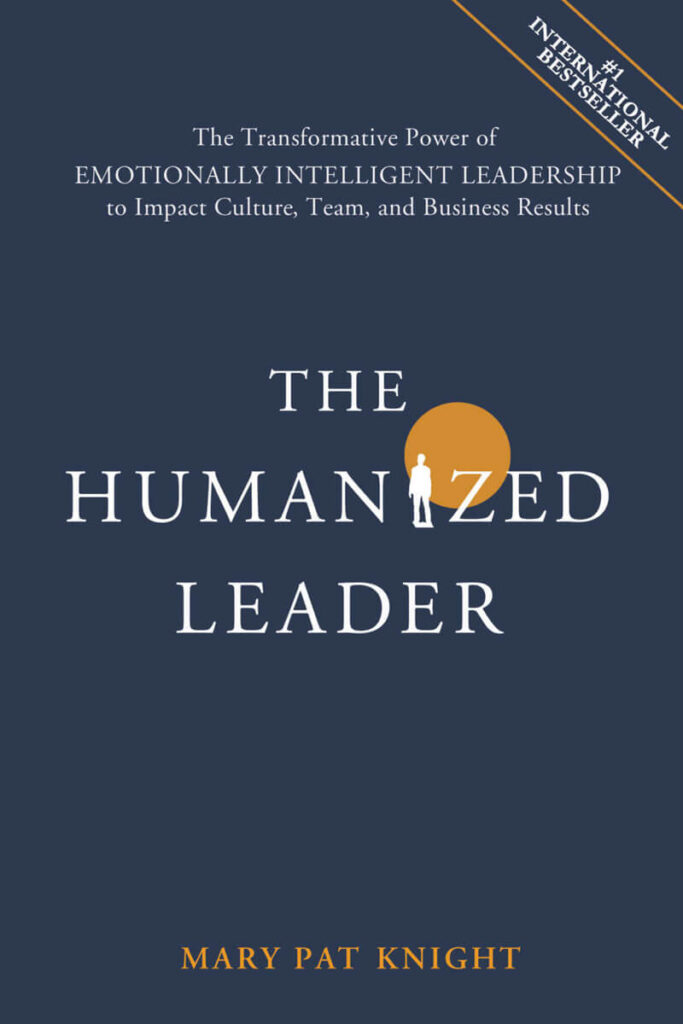
Mary Pat Knight is CEO of Leaders Inspired – an executive coaching and consulting agency devoted to the development of emotionally intelligent leaders. She is also the author of the Amazon #1 International Best Selling book, The Humanized Leader.
The ground-breaking new book, The Humanized Leader: The Transformative Power of Emotionally Intelligent Leadership to Impact Culture, Team and Business Results, is now available in Kindle, paperback, or as an audiobook. To get your copy – or extras for your team, click the button below.