

How Much Evidence Will It Take?
He was in the middle of making a pretty convincing case for his own inadequacy.
He had missed the mark. He wasn’t showing up with enough confidence. People were probably disappointed in him. As he talked, one piece of evidence led neatly to the next. I could hear how familiar the story was to him. This wasn’t something he was making up for our conversation. He believed it.
Then his phone buzzed.
A senior leader in the organization had sent him a message acknowledging his work and contribution, along with a substantial bonus.
He looked at the message and laughed.
For the last several minutes, he had been telling me why he wasn’t measuring up. At almost exactly the same moment, someone with a very real stake in his performance had decided to recognize his work in a very tangible way.
The timing was almost too good. But what interested me wasn’t that the bonus proved him wrong. It was how much evidence his failure story had been able to gather before something that concrete finally interrupted the pattern.
Conversely, how much evidence will it take to dislodge a story we've decided is true?
An old colleague and I used to call one version of that internal chorus the “itty bitty shitty committee.” It was our shorthand for the voices that could build a surprisingly convincing case against you. The name made us laugh, but the voice itself could be remarkably persuasive.
I’m less willing these days to dismiss every doubtful voice as the committee, though. Sometimes self-doubt is information. There may be something we don’t know yet or a skill we haven’t developed. The role may be asking something of us that we’ve never had to do before, and the discomfort we’re feeling is simply telling us that we’re going to have to grow into it.
That’s part of what makes self-doubt so difficult to sort out, and why our failure stories are so resistant to evidence. The voice that says, “Pay attention, you have something to learn here,” may not sound all that different from the one that has been telling you for years that you aren’t quite enough.
I’ve seen versions of this across the leaders I coach, particularly when their role has changed faster than their sense of themselves inside it. The title changes, the responsibility gets bigger, but some part of them is still standing outside the door wondering whether they’re really supposed to walk through it.
That was exactly what was happening with the leader whose phone had buzzed.
As we dug into his story, he described a situation where he hadn’t spoken up about something he believed he should be part of. He seemed to be waiting for someone else to decide whether he belonged in the room.
He sat with that for a moment and then said, “I guess I don’t feel I have the right to say I need to be there.”
I asked him why, and he didn’t have a fast answer. He knew the people in that room were his peers. His role gave him standing to be there. But knowing that organizationally and believing it about himself appeared to be two different things.
Several sessions later, something shifted for this leader. Without a bonus arriving or anyone else telling him what he was worth, he began talking about what he brought to a room that had intimidated him for months. He could think at the level the room required while still holding onto what mattered to the people actually doing the work.
He said it plainly. He wasn’t trying to convince me, and for once he didn’t seem to be trying to convince himself. I noticed the difference.
But I also knew better than to declare victory.
The old story has come back since then.
Some weeks he sees his contribution clearly. Other weeks, the case against himself begins assembling again. The evidence didn’t make the story disappear forever, and neither did one moment of seeing himself differently.
I’m not sure I’d want self-doubt to disappear entirely. A leader who never questions whether they know enough, are seeing clearly, or are ready for what they’re taking on presents a different problem.
But I keep thinking about that moment when his phone buzzed.
For a few minutes, the story he knew so well ran directly into evidence that didn’t agree with it. He laughed because there it was, right in front of him, at the exact moment he was making such a convincing argument for the opposite.
How easily something we’ve believed for a long time can continue to feel true, even when there is evidence sitting right in front of us that says otherwise.
How much evidence will it take?
Author’s note: This piece was inspired by a real conversation, but it is not a literal account. Details have been changed to protect the privacy of the people involved.
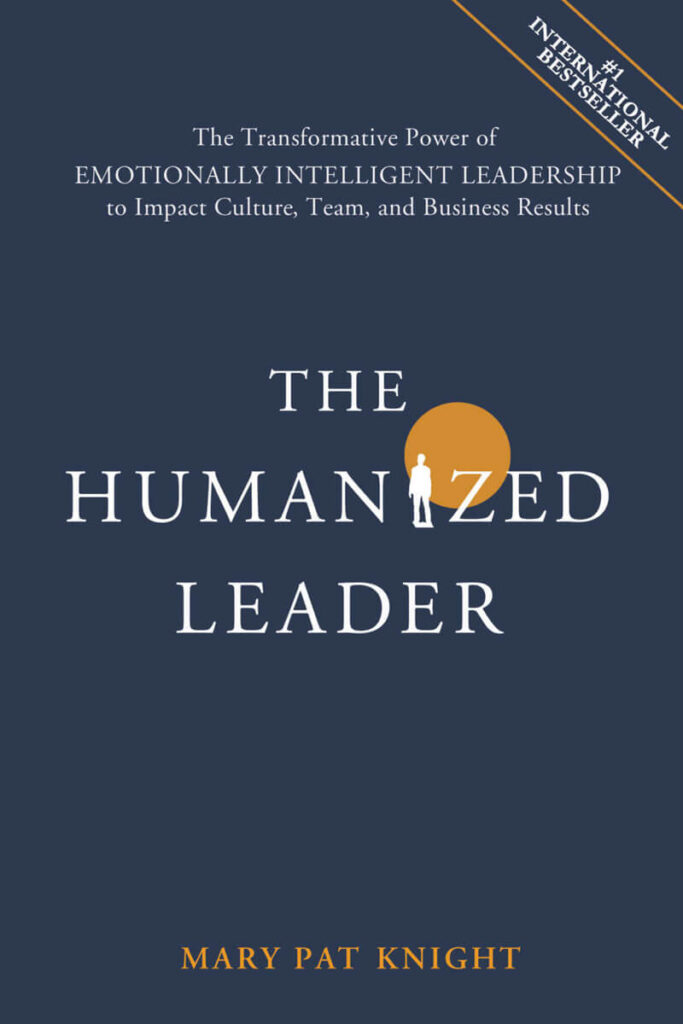
Mary Pat Knight is CEO of Leaders Inspired – an executive coaching and consulting agency devoted to the development of emotionally intelligent leaders. She is also the author of the Amazon #1 International Best Selling book, The Humanized Leader.
The ground-breaking new book, The Humanized Leader: The Transformative Power of Emotionally Intelligent Leadership to Impact Culture, Team and Business Results, is now available in Kindle, paperback, or as an audiobook. To get your copy – or extras for your team, click the button below.