

Why the Triangle Never Runs Out of Cast Members
The triangle doesn't need villains. It needs you.
You do not need difficult people to sustain a Drama Triangle. You need good ones. People who care about the work show up early and take the mission personally. The triangle does not thrive because people are broken or ill-intentioned. It thrives because they are caught in patterns of behavior that have never been questioned, have been long tolerated, and have become the norm.
Most of us recognize the triangle first in situations we are watching, not living. We see the team meeting where one person carries the workload. We notice the colleague who generates chaos. We spot the dynamic that repeats regardless of who is in the room. The pattern is easier to name from the outside. What is harder to see is that the outside does not exist. You are always somewhere in the triangle.
The three roles are Hero, Victim, and Villain. The labels are theatrical by design, but what they point to is concrete. Each role carries predictable, observable behavior. The hero moves toward problems, often before being asked. The victim pulls back from them, often without realizing it. The villain, usually without intention, creates the friction that sets the dynamic in motion. These behaviors shape around the roles the way water shapes around stone. You do not have to name the role to see the behavior. Once you know what you are looking at, you see it everywhere.
Every role feels justified from the inside. The hero does not rescue out of ego. The hero rescues because someone needs help, they can provide it, and the clock is running. The victim is not being passive. The victim has learned, through repetition, that the hero arrives before their own capability can be demonstrated. The villain is not manufacturing conflict. The villain typically sees the problem clearly, moves on it before others are ready, and runs out of patience long before consensus catches up.
Reasonable people. Reasonable behavior. Triangle running at full capacity.
It runs because we have normalized it. We mistake the hero’s over-functioning for high-performance leadership. We mistake the victim’s hesitation for cautious diligence. We mistake the villain’s impatience for urgency. We have built environments where these roles are not just accepted — they are rewarded with the illusion of progress. The triangle does not signal that something has gone wrong. It signals that we have stopped doing the harder work of asking why capable people keep landing in the same positions.
Shifting out of the triangle does not come from working harder at the behaviors. Redistributing tasks, rewriting team norms, and offsite agreements have value, but they do not reach the root. What moves the needle is a change in perception — specifically, how you see the people around you before you decide what they need from you.
Before you move toward a problem someone else is holding, ask what role you are about to play and whether playing it serves them or resolves your own discomfort. Then look again at the person in front of you. Not the version that needs your intervention. The version that is capable of working through it.
Then ask the harder question: where is your leadership reinforcing the pattern? Over-directing suppresses autonomy and feeds the victim dynamic. Avoiding honest conversation protects the villain pattern. Rescuing someone who could find their own way feeds the hero dynamic in both directions. Leaders who can see their own fingerprints on a dynamic are far better positioned to change it than leaders who can only see the behavior in front of them.
See a Creator where you have been seeing a Victim, and the rescue loses its object. See a Problem Solver where you have been seeing a Villain, and the conflict loses its charge. See a peer or a potential mentor in the person you have been managing around, and a path of development opens where there was only friction. The triangle does not collapse because you withdrew from it. It collapses because the cast changed in your eyes, and the roles you were playing against no longer hold.
This is not a decision you make once. It is a practice you choose repeatedly. The triangle is magnetic. It offers the immediate relief of being the hero or the righteous certainty of being the victim. Moving toward a different way of relating — one rooted in observation rather than intervention — is uncomfortable precisely because it requires you to stay with friction you were previously trained to resolve.
It starts with a different question. Not what is wrong with the people in this room, but what has your presence been asking of them.
The triangle never runs out of cast members because the cast is always willing. Good people, trying hard, doing what the system trained them to do.
They are waiting for you to stop directing the play. The system includes you. You are the only one who can change the script.
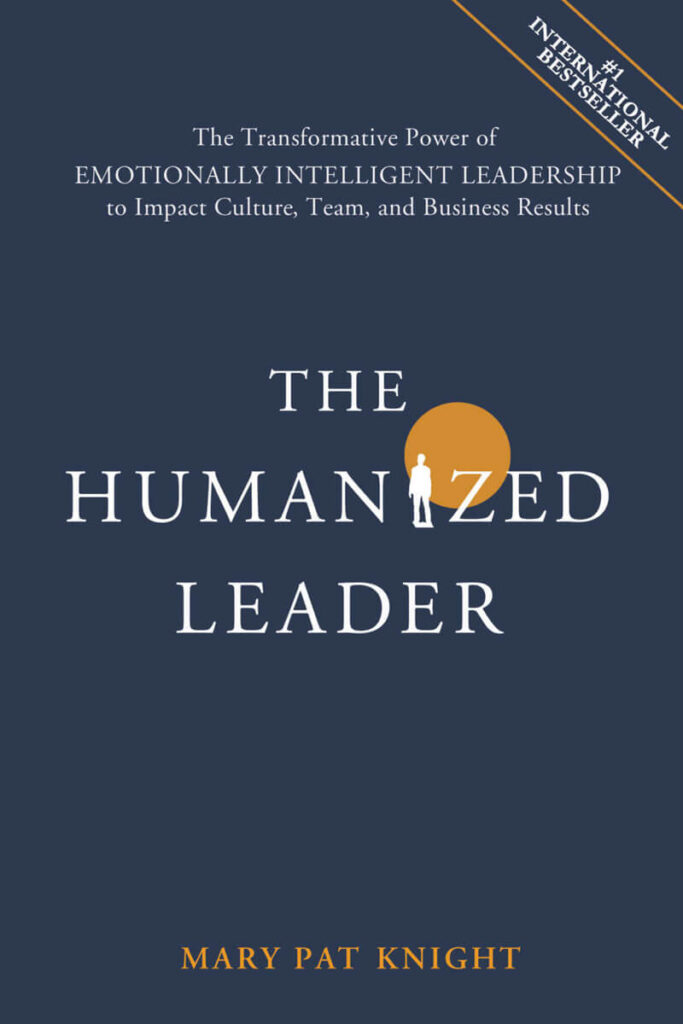
Mary Pat Knight is CEO of Leaders Inspired – an executive coaching and consulting agency devoted to the development of emotionally intelligent leaders. She is also the author of the Amazon #1 International Best Selling book, The Humanized Leader.
The ground-breaking new book, The Humanized Leader: The Transformative Power of Emotionally Intelligent Leadership to Impact Culture, Team and Business Results, is now available in Kindle, paperback, or as an audiobook. To get your copy – or extras for your team, click the button below.