

Why Leaders Avoid Hard Conversations
(And What It Costs Everyone)
One of the most common pain points I encounter when meeting with a new client is accountability. Someone will confide, “We need more of it.” And then, almost in the same breath, they start describing just how hard it actually is to practice.
What strikes me is that these conversations almost always hold two perspectives at once. Leaders describe the accountability gaps they see in their teams and then, upon reflection, they acknowledge how challenging it can be for themselves. This admission comes not as an abstract observation, but as something they are actively navigating.
They want people to follow through, honor commitments, and own their work. Yet when the moment arrives to clarify an expectation, address a performance issue, or revisit an agreement, something hesitates. The timing never quite feels right. The conversation starts to feel like it will cost too much. It will cost too much time, too much thought, too much emotional energy. So, leaders tell themselves they will get to it later, when they can really give it the attention it deserves.
That later moment rarely shows up.
Instead, expectations soften, and feedback gets delayed. Small misalignments accumulate. Work gets redone, frustration builds in the background, and the leader ends up having the harder version of a conversation they could have had weeks ago, under far less favorable conditions.
The Fear Underneath the Avoidance
This pattern almost never comes from a lack of care. In fact, it often comes from caring too much. More precisely, it comes from caring about the wrong thing in the moment.
What most leaders are actually afraid of is not the conversation itself. It is what the conversation might cost them. Will the relationship survive it? Will the other person become defensive, shut down, or pull away? Will I damage something I have worked hard to build? Those questions do not always surface consciously, but they are almost always present, and they are far more powerful than a simple preference for avoiding conflict.
I know this not only from years of working with leaders, but from living it myself. I have watched someone I love move toward the equivalent of a train they could not yet see, and I held back, not because I did not care, but because I was afraid. Afraid of overstepping. Afraid of rocking something fragile. Afraid that saying what I saw would cost me the relationship rather than protect the person. That tension has not fully resolved. I still navigate it, still remind myself regularly what is mine to carry, and what belongs to someone else. The work is ongoing, and I am not immune to the same hesitation I observe in the leaders I coach.
What I have learned, both personally and professionally, is this: the absence of a hard conversation is never neutral. Silence has a cost, and that cost is almost always paid by someone other than the person who chose to stay quiet.
What Leaders Can and Cannot Do
This is where I want to share a bias I hold, and I will be upfront about it.
I do not believe leaders can truly hold another adult accountable. The phrase itself implies that accountability is something done to someone, a form of pressure or enforcement designed to compel performance. And in practice, that approach rarely holds up for long.
What leaders can do is demonstrate the kind of leadership and create an environment where people choose to be accountable. That means establishing clear expectations, speaking truthfully about what is working and what is not, and making sure people understand where they stand and what they can do to move forward successfully.
Leadership is about creating conditions, not controlling behavior.
When those conditions exist, accountability starts to look and feel different. People are not guessing what success looks like or wondering where they stand. They understand the work, the expectations, and their role in achieving the outcome. That clarity frees people to focus their energy on improvement rather than interpretation.
Adults do their best work in environments where expectations are visible, and progress can be discussed openly. Knowing where you stand builds trust. Knowing what you can do to improve builds engagement. Very few people start their day hoping to miss the mark, and most people genuinely want to succeed, and they benefit from leadership that helps them see the path.
FDNK: A Framework for Conversations That Actually Land
One communication framework I return to often in my leadership work is what I call FDNK: Factual, Direct, Neutral, and Kind.
This approach is a reminder that candor does not need to be sharp to land effectively. Each element does specific work. Factual means grounding the conversation in observable reality rather than interpretation or assumption. Direct means saying the thing that needs to be said without burying it in qualifications. Neutral means keeping the emotional temperature steady enough that the other person can actually hear what you are offering. And Kind means holding the person’s success as the genuine goal of the conversation, not just the resolution of your own discomfort.
That last point is where kindness and niceness part ways. Being nice often grows out of familiar and understandable motives (think of people-pleasing, avoiding tension, protecting the relationship, or preserving our image as a supportive leader). Those instincts are not bad. But they can lead us to soften or delay the clarity someone genuinely needs from us.
Kindness operates from a different place. Kindness is willing to bring both pressure and genuine care into the conversation, because the goal is the person’s success, not the comfort of the moment. A kind conversation can be uncomfortable. It can press. It can name what is not working with enough directness that the other person cannot look away. And it can do all of that without cruelty, without judgment, and without leaving the person feeling diminished.
That is the standard FDNK asks us to hold.
Accountability as a Cycle, Not a Confrontation
When leaders communicate from this stance, accountability conversations stop being dramatic events and become part of the normal rhythm of work.
That rhythm makes more sense when we think about performance as a cycle rather than a single conversation. Expectations are set so success is visible. Training and resources ensure people have the capability to meet those expectations. Coaching helps individuals refine their approach. Feedback keeps the work aligned. And appreciation reinforces the behaviors that move the team forward.
The real world is messier than any cycle suggests, and most leaders are building this infrastructure while also trying to use it. That is normal, and it does not disqualify the model. It simply means that the work of creating a culture of accountability is ongoing rather than something you complete and set aside.
Inside that cycle, accountability stops feeling like enforcement and starts feeling like support. It becomes a shared understanding of what success looks like and a shared commitment to keep getting better together.
The Conversation You May Be Avoiding With Yourself
Before closing, I want to name something that often goes unspoken in conversations about accountability.
The hardest accountability conversation most leaders are avoiding is not with a team member, a peer, or a direct report. It is with themselves. The same clarity, courage, and kindness they are being asked to bring to others is the thing they most need to turn inward. They must look at the standards they are holding themselves to, the commitments they have let slide, and the places where they are asking more of others than they are currently willing to ask of themselves.
That territory is rich enough to deserve its own exploration, and we will return to it. For now, it is simply worth naming: the leader who does the internal work is the leader whose external conversations land differently. Not because they have achieved perfection, but because they are not asking anyone to do something they are unwilling to do themselves.
The Challenge This Moment Is Asking You to Meet
Leadership does not eliminate tension. Every role carries expectations, responsibility, and moments when the truth needs to be spoken clearly. The work of leadership is not to avoid those moments. It is to meet them with steadiness and respect.
But I want to go one step further than that, because the moment we are living in asks for it.
The leaders reading this are steering organizations, teams, and relationships in a world that is short on accountability at every level. People are watching governments and institutions avoid hard conversations, defer consequences, and soften the truth until it no longer resembles itself. The cost of that pattern is visible everywhere, and it is accumulating.
You have the opportunity to be different. Not perfect, because none of us are, but different. To be the kind of leader who does not look away when something needs to be said, who does not delay a conversation because the timing is inconvenient, and who does not pass the unresolved tension of today to the people who will have to lead tomorrow.
That is the work. It is not always comfortable, and it is rarely finished. But when clarity is offered with steadiness and respect, it is rarely experienced as harsh.
More often, it lands as exactly what it is: an act of respect, and an act of leadership that this moment genuinely needs.
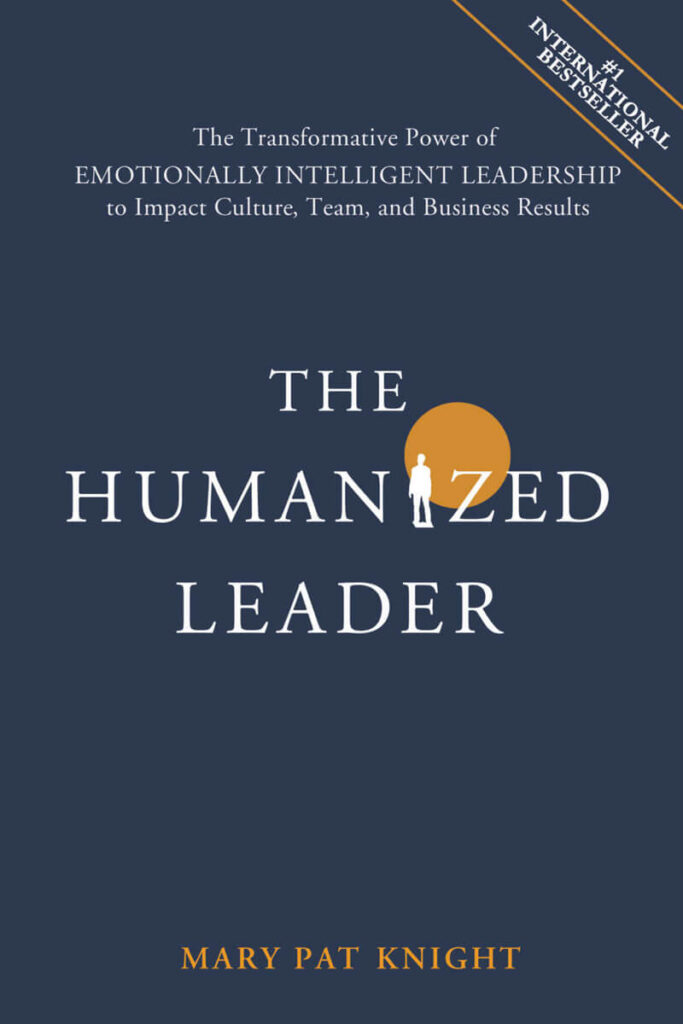
Mary Pat Knight is CEO of Leaders Inspired – an executive coaching and consulting agency devoted to the development of emotionally intelligent leaders. She is also the author of the Amazon #1 International Best Selling book, The Humanized Leader.
The ground-breaking new book, The Humanized Leader: The Transformative Power of Emotionally Intelligent Leadership to Impact Culture, Team and Business Results, is now available in Kindle, paperback, or as an audiobook. To get your copy – or extras for your team, click the button below.