

When Outrage Feels Justified
A Leadership Perspective on Anger, Discernment, and What Comes Next
There is something undeniably energizing about outrage.
You can feel it in the body almost immediately. Certainty sharpens. The line between right and wrong seems to be clearer. Someone must be called out.
Outrage can feel powerful. It can feel like moral clarity. It can even feel like leadership.
And right now, for a lot of people, it can also feel justified.
That last part matters. Because before I say anything else, I want to name something directly: we are not living in ordinary times. People are watching institutions behave in ways that challenge deeply held values. Leaders in positions of public trust are acting without accountability. Things that would have been disqualifying a few years ago are being normalized at a pace that is genuinely disorienting. If you are outraged, there is likely something real underneath that. Your reaction is not a character flaw. It is not a sign that you have lost perspective.
It is a signal. And signals deserve our attention.
The question I want to sit with in this article is not whether outrage is understandable. It often is. The question is what we do with it, and whether, over time, we allow it to replace the harder and more demanding work of discernment.
Anger and Outrage Are Not the Same Thing
This distinction is the heart of everything that follows, and I want to give it the space it deserves.
Clean anger is a healthy emotional response. It arises when something meaningful is violated, be that a boundary, an agreement, a value, or a person’s dignity. It has a beginning and a direction, moving us toward action that addresses the source. Clean anger can produce courage, prompt honest conversation, and lead to accountability. When leaders act from clean anger, they tend to move toward the problem with clarity and intention.
Outrage is something different, and the difference is not about intensity. You can be deeply and legitimately angry without crossing into outrage.
Outrage tends to linger in ways that clean anger does not. It builds identity around being wronged. It gathers others who reinforce the same interpretation and rewards us socially and emotionally for strengthening the story. The emotional intensity becomes its own source of momentum, and that momentum starts to feel like purpose.
Here is the question I use with myself and with clients to test which one is present: Am I moving toward resolution, or am I moving toward being right?
Clean anger wants resolution. Outrage wants vindication.
Both can feel identical from the inside, and that is what makes this so difficult to navigate.
What Outrage Does to Our Thinking
When outrage takes hold, several things happen that are worth naming plainly.
The story simplifies. Someone becomes the villain, and someone else becomes the victim. The facts that support the narrative rise to the surface while everything that complicates it fades. This is not dishonesty; it is the way the human mind works under emotional activation. But it means that the picture we are working from is incomplete, even when our underlying concern is legitimate.
Curiosity fades. It becomes harder to ask genuine questions, to consider alternative explanations, or to hold the possibility that the situation is more complex than it first appeared. Dialogue becomes difficult. And accountability, particularly self-accountability, leaves the conversation.
This is also happening at a scale none of us has experienced before. Outrage is not just personal right now. It is tribal and algorithmic. The platforms most of us use every day are designed to reward emotional intensity. Peer groups reinforce it. The most activated voices get the most amplification, which means that even people with good judgment and genuine values are swimming against a current that keeps pulling them back toward reaction.
Naming that context is not an excuse. It is important information for anyone trying to lead thoughtfully right now.
The Drama Triangle and the Cost of the Victim Role
In my leadership work, I often teach a framework called the drama triangle. It describes the way people move between three roles when tension rises: victim, villain, and hero.
Outrage finds its most visible home in the victim role. When we occupy that position, it can feel as though someone else holds all the power while we hold all the moral ground. The story is clean and compelling. But it also places responsibility outside of self, and once that happens, meaningful leadership becomes much harder to exercise.
What is less often discussed is how outrage fuels the hero role as well. The hero is not personally wronged but performs outrage on behalf of others as they step in, speak for others, and position themselves as the one willing to say what needs to be said. This can look like leadership. It can even feel like it. But when it is driven by outrage rather than discernment, it tends to generate heat without producing much light.
Both roles share the same core feature: responsibility lives somewhere other than here.
What Discernment Actually Requires
I want to be direct about something: discernment is not a call to be calm. It is not a suggestion to minimize what is happening or to make peace with behavior that deserves to be challenged. Asking for discernment when things are genuinely difficult is not the same as asking people to sit down and stay quiet.
Discernment is actually more demanding than outrage. It asks us to do something harder than react.
It asks us to separate fact from interpretation, not to dismiss our interpretation, but to know which is which. It asks us to examine our own reactions before we amplify them. It asks us to consider what outcome we actually want and whether our current behavior is moving us toward it. And it asks us to stay present with complexity rather than collapsing it into a cleaner story that seems easier.
That last one is genuinely hard right now. The situations many leaders are navigating are complex. The right response is not always obvious, and the pressure to pick a side, take a stance, and signal clearly which team you are on is intense.
Discernment says: before you lead from this feeling, sit with it. Pause. Look it over.
That pause does not mean nothing happens. It means what happens next comes from your values and your judgment rather than from the momentum of the moment.
Leading From the Other Side of It
Mature leadership does not eliminate anger or pretend that injustice should be absorbed. It does not ask leaders to perform equanimity they do not feel. What it does ask is this: that we process our emotional reactions before we lead from them, so that what we bring to others is our wise response, not just our reactive activation.
None of this is simple to practice in the middle of a moment that has genuinely activated you. But a few disciplines, applied with intention, can make the difference between leading from your values and leading from your nervous system.
Taking time before responding publicly is perhaps the most important pause available to a leader right now. This is not meant to avoid the response, but to ensure it reflects your thinking rather than just your feeling. Separating what is factual from what you believe you believe matters just as much. Facts inform. Beliefs interpret. Knowing which one you are leading with at any given moment is one of the most underrated disciplines in leadership communication. Asking yourself what resolution actually looks like, and whether the action you are considering moves toward it, keeps the work anchored in outcome rather than emotion. And choosing the harder conversation over the easier performance is where it all comes together. Real accountability requires presence and directness. Outrage often substitutes visibility for both.
The leaders I most respect right now are not the ones who are loudest. They are the ones who have found a way to stay in contact with what is real, name it clearly, and act from their values even when the pressure to simply react is significant.
That is not passivity. That is the hardest form of leadership there is.
What To Do With What You Are Feeling
And it begins before you act.
There is a version of action that looks like leadership but functions more like relief. It is the move made too quickly, before the internal work is done, driven more by the need to discharge the feeling than by a clear sense of what needs to happen next. That kind of action tends to land in the muddied water of unresolved triggers, generating reaction in others, deepening division, and leaving the leader less credible than before, not because their concern was wrong but because the delivery was driven by activation rather than intention.
The transformation from outrage to purposeful action is not something that happens to you. It requires a personal commitment that most people underestimate: the willingness to turn toward your own interior before you turn toward the situation. To ask not only what is wrong out there, but what is being asked of me in here. That is not a comfortable question, and it is not a quick one, but it is the question that separates leaders who generate heat from leaders who generate change.
Your outrage may be completely justified. The situation may be genuinely unjust. And you may still be responsible for what you do with that feeling before you act on it. Those three things can all be true at the same time, and holding all three simultaneously is precisely what mature leadership requires right now.
If you have read this far and your outrage is still intact, that is not a failure of understanding. It may be exactly the right response to what you are witnessing. The goal of everything written above is not to talk you out of what you feel. It is to help you do something more powerful with it than simply carry it.
Sitting with outrage without acting on it immediately is genuinely uncomfortable, and most people need permission to take that pause without feeling as though they are betraying the seriousness of the moment. So, consider this permission. The pause is not passivity. It is the space where reaction becomes response, and where feeling becomes force.
In that space, one question tends to cut through more than any other: What does this feeling know that I need to pay attention to, and what is the most meaningful action available to me right now? Not the loudest action, not the most visible one, not the one that signals most clearly which side you are on. The most meaningful one. The one that actually moves something in the direction of what you believe. That question will not always produce an immediate answer, and that is fine. Sitting with it honestly is itself a form of leadership.
Outrage that has been metabolized into purposeful action is one of the most powerful forces a leader can bring to bear on a broken or unjust situation. It retains the energy and the moral conviction of the original feeling, but it adds wisdom, direction, and the credibility that comes from having done the internal work first. The world does not need leaders who have extinguished their anger. It needs leaders who have learned what to do with it. It needs leaders who can walk into the room having already wrestled with their own reaction, and who can therefore speak and act in ways that others can follow.
That is not a small thing. Right now, it may be the most important thing.
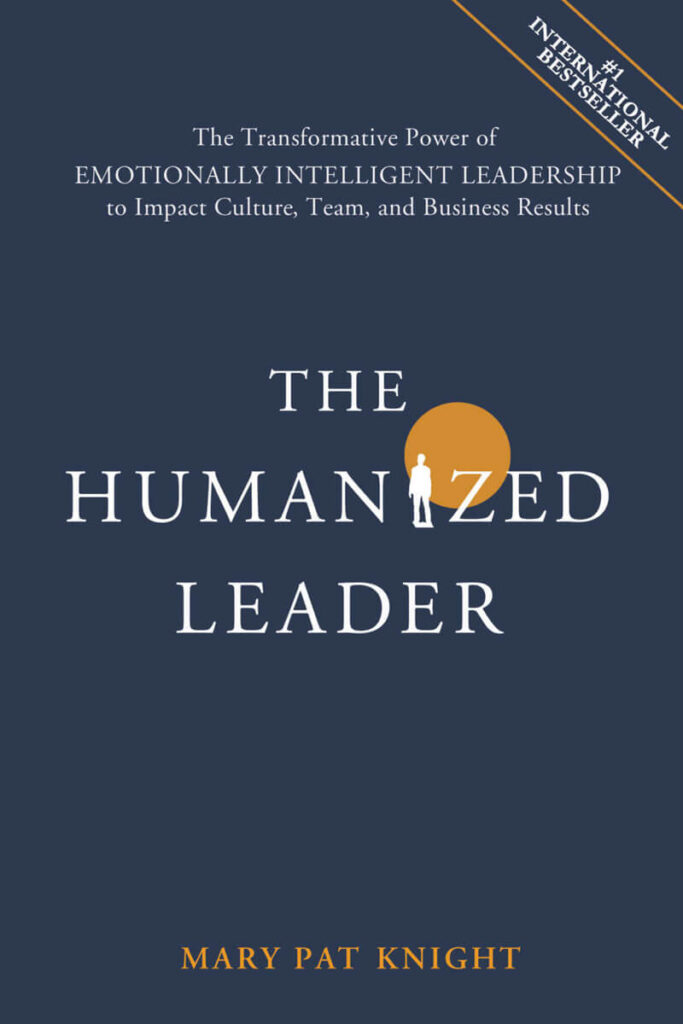
Mary Pat Knight is CEO of Leaders Inspired – an executive coaching and consulting agency devoted to the development of emotionally intelligent leaders. She is also the author of the Amazon #1 International Best Selling book, The Humanized Leader.
The ground-breaking new book, The Humanized Leader: The Transformative Power of Emotionally Intelligent Leadership to Impact Culture, Team and Business Results, is now available in Kindle, paperback, or as an audiobook. To get your copy – or extras for your team, click the button below.