

The Laboratory
I was on the phone with a client last week when she said something I’ve heard a hundred times, in a hundred different ways.
She had delegated a project to a team member, the result had fallen short, and she was frustrated. Not furious, just disappointed that something she had confidently handed off came back wrong. She’d already run the story twice in her head before she got to me. The team member hadn’t followed through. The direction had been clear. She shouldn’t have to spell everything out.
I let her finish.
Then I asked her one question: what was your accountability conversation before the work started?
There was a pause.
A long one.
I didn’t really have one. I just assumed she knew what I needed.
Right there — in that pause, in that admission — was the experiment. Not the team member’s performance. Not the outcome. The moment before the work started, when the direction was given without the structure that would have made it land. That was the data. And once she could see it without making herself wrong or making her team member the problem, she knew exactly what to do differently next time.
That’s the laboratory. And it is always open.
“The unexamined life is not worth living.” Socrates said this at his own trial, in defense of a life spent asking hard questions. He considered that examination so essential he chose death over abandoning it. I’d add a smaller but no less serious corollary: the unexamined leadership moment is just wasted experience.
I introduce this concept early with clients. You are a scientist, I tell them, and your life is the laboratory. Everything that happens, including the conversation that went sideways, the decision that didn’t land, the moment you handled better than you expected, is an experiment. Your job isn’t to judge it. Your job is to examine it.
This sounds simple. It is not easy.
Because the moment something goes wrong, most of us abandon the laboratory entirely. We walk straight into one of two rooms. The first is the room where we make it mean something terrible about ourselves. I should have known better. I always do this. What is wrong with me. The second is the room where we make it someone else’s fault. They didn’t follow through. The timing was off. No one told me. Both rooms feel like conclusions. Neither one is data.
The scientist doesn’t go to either room. The scientist stays in the lab and asks: what actually happened, and what does it tell me?
A framework I use called Like Most, Do Different helps here, not as a formal debrief tool, but as a thinking posture. Two questions, applied honestly to any experiment.
What worked? Not what you wish had worked, not what should have worked by rights. What actually worked. Where was the chemistry right? What produced the result you wanted, even partially?
What would you do differently? Not what should the other person have done, not what the circumstances should have been. What is inside your control to change next time?
Those two questions keep the experiment honest. They don’t require perfection, and they don’t require suffering. They just require looking.
A client told me recently that he had been practicing his listening — really practicing, paying attention to his filters, staying in the conversation instead of racing ahead to his response. One evening his wife said to him, unprompted, that she felt genuinely heard. He brought it to our next session like evidence, because that’s exactly what it was. Experiment designed, experiment run, result noted. He knew what had worked and he knew he wanted to keep doing it. Simple science.
The experiments don’t have to be dramatic to be instructive. Most of the best ones aren’t.
What gets in the way isn’t a lack of experience. Every leader has experience. What gets in the way is the relationship with experience — specifically, the inability to examine it without self-condemnation or exporting the responsibility to someone else.
This is where the Drama Triangle shows up in the laboratory. The victim of the experiment says the result happened to them, be it circumstances, other people, or bad timing. The villain says someone else caused it. The rescuer swoops in to fix the result without ever examining what produced it. All three roles feel like movement. None of them produce data.
The scientist is none of these. The scientist is the observer who is steady enough to look at what happened without needing it to mean something final about who they are. That posture is a choice, and it takes practice. Self-condemnation is a habit most leaders developed long before they had a title. It feels like accountability. It isn’t. Real accountability examines the experiment, extracts the learning, and decides what changes next time. It doesn’t require punishment.
The laboratory metaphor matters because of what a laboratory actually is.
It is not a place where things go right. It is a place where things are examined. Some experiments confirm the hypothesis. Some disprove it. Some produce results nobody expected. All of them, examined with rigor and without judgment, move the science forward.
Your leadership life works the same way. The conversation that landed badly is data. The decision you’d make differently is data. The moment you stayed regulated when everything in you wanted to react — that’s data too, and worth examining just as carefully as the failures.
The question isn’t whether your experiments will be clean. They won’t be. The question is whether you’re willing to stay in the laboratory long enough to find out what they’re telling you.
Growth lives in that willingness. So does everything that comes next.
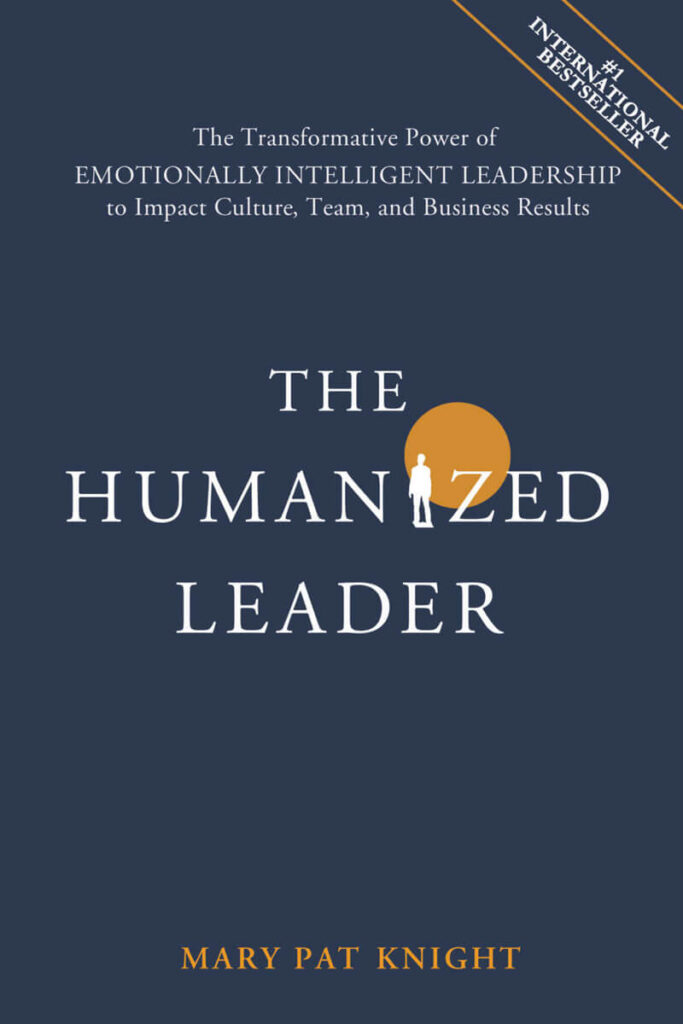
Mary Pat Knight is CEO of Leaders Inspired – an executive coaching and consulting agency devoted to the development of emotionally intelligent leaders. She is also the author of the Amazon #1 International Best Selling book, The Humanized Leader.
The ground-breaking new book, The Humanized Leader: The Transformative Power of Emotionally Intelligent Leadership to Impact Culture, Team and Business Results, is now available in Kindle, paperback, or as an audiobook. To get your copy – or extras for your team, click the button below.