

My Business Was to Do My Business
On courageous action, staying in your lane, and what opens up when you stop managing what was never yours to manage.
A few years ago, I found myself in a friendship that had developed a low hum of friction I couldn’t quite name. We were both building something. Both driven. The kind of women who show up fully and expect the same from themselves in every room they enter.
Somewhere in that mix, I started measuring. It wasn’t conscious at first. I was tracking her progress against mine. I used her wins and her trajectory as an unofficial benchmark for where I was supposed to be. I didn’t want to judge it as competition, it felt like paying attention. Until I noticed what it was costing me.
Then I realized I was ghosting my own life to watch hers.
Every time I looked sideways at what she was building, I lost contact with what I was building. My own instincts got fuzzier. My judgment got muddier. The comparing pulled me out of my lane so gradually I barely noticed I’d drifted. Until I did notice.
The courageous action wasn’t dramatic. I didn’t have a conversation or create distance from the friendship. I made a decision, cleanly and without fanfare, to get back in my own business and stay there. Her path was hers. Mine was mine. What she did or didn’t do, how fast or slow she moved, and what she chose was never mine to hold.
When I stopped, something opened up. My clarity came back. The work in front of me got sharper. I could feel my own instincts again without the static.
That is what courageous action actually looks like a lot of the time. It is a redirection of your own attention back to where it belongs.
The Executive Lane-Drift
Leaders leave their lane in more ways than one. Think about what it looks like inside an organization on any given week.
A senior leader watches a peer struggle and jumps in. Although they may think otherwise, they don’t do it to be helpful, they do it because they can’t stomach the awkwardness of the delay. A manager keeps rewriting work their team has already done because their standards aren’t yet aligned. They don’t know how to close that gap without just doing it themselves. A CEO involves themselves in a decision three layers below their authority because something feels off.
Waiting feels worse than acting.
They think they’re helping or protecting the outcome. Sometimes, they are. But the harder question is whether the action serves the actual need or whether it simply numbs the leader’s own anxiety at the expense of the team’s growth.
There is a version of this that goes in the other direction. A leader who inflates their own authority, who speaks for others without permission, or who positions themselves as the answer to problems that were never theirs is also outside their lane. It just looks different. One version reaches down. The other reaches sideways. Both have lost the thread of what is actually theirs to do.
Precision over Power
The question that keeps finding me in coaching and in my own work is simple, but it has teeth: What is actually mine here?
Not what could I do. Not what am I capable of. What is mine? What falls inside the boundary of my genuine authority and my responsibility to affect an outcome without robbing someone else of their own learning?
Sometimes the answer is to do more of the doing. Step in. Act.
More often than most leaders want to admit, the answer is less. Pull back. Trust the other person to work it out. Hold your ground without expanding your footprint into territory that belongs to someone else.
I have a person in my life right now whose situation I care about deeply and cannot fix. Her path forward requires work that only she can do. My business is not to be the architect of her recovery or map her next step. My business is to love her and then to step back so she has the space to do her own work. That kind of restraint, when everything in you wants to move toward someone in pain, is one of the harder forms of courageous action I know.
Staying in your lane is not passivity. It is precision. It requires you to know yourself well enough to see when you are acting from clarity versus acting from anxiety. It requires enough self-trust to believe that doing your work fully is enough. You don’t have to do everyone else’s work too in order to matter.
The leaders who have the most impact over the long run are not the ones who are everywhere at once. They are the ones who are completely present in their own business. They have learned to let everyone else be present in theirs.
Where have you been leaving your lane lately? And what do you think is keeping you there?
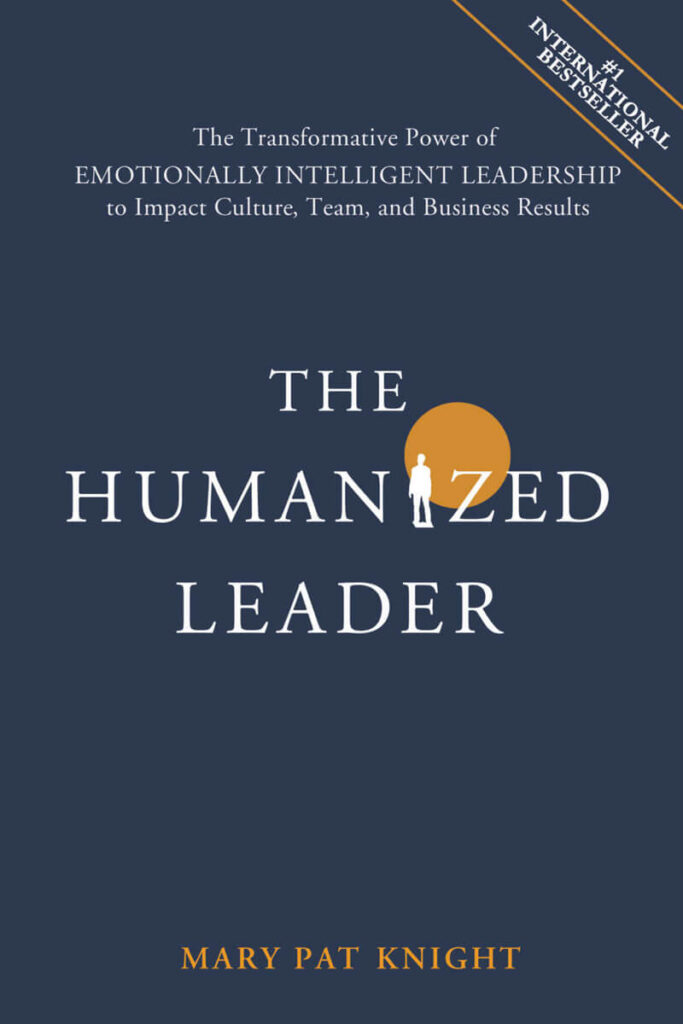
Mary Pat Knight is CEO of Leaders Inspired – an executive coaching and consulting agency devoted to the development of emotionally intelligent leaders. She is also the author of the Amazon #1 International Best Selling book, The Humanized Leader.
The ground-breaking new book, The Humanized Leader: The Transformative Power of Emotionally Intelligent Leadership to Impact Culture, Team and Business Results, is now available in Kindle, paperback, or as an audiobook. To get your copy – or extras for your team, click the button below.